Tuesday, October 31, 2006

Interpretation

Regina Angelorum

It is the essence of Romanism that the authority of the living church interprets to the individual believer the meaning of the word 'God' and the word 'Christ.' What the Bible says to the individual is mediated through the declarative activity of the church which is assumed to be infallible.

- Cornelius Van Til

Maybe I'm missing something here, but wasn't the entire reason for the Council of Nicea to interpret to the individual believer the meaning of the words "God" and "Christ" in such a way that if a believer were to disagree with Nicea the believer is understood to be wrong?

Wednesday, October 04, 2006

Faith & Reason

Regina Angelorum
What has Athens to do with Jerusalem? - Tertullian

My answer: Rome.

Saturday, September 30, 2006

Grace and Merit

Regina Angelorum

The "classical Protestant" position on merit might be summarized as, "All is grace, therefore there is no merit." To someone who accepts this view, Catholic talk about merit on the part of human persons can seem like a denial of God's free (unearned) gift of grace. Thus the vehemence with which the idea of human merit is sometimes attacked.

But does Catholic talk of human merit actually amount to a denial of the unearned character of grace?"

426. What is merit?

In general merit refers to the right to recompense for a good deed. With regard to God, we of ourselves are not able to merit anything, having received everything freely from him. However, God gives us the possibility of acquiring merit through union with the love of Christ, who is the source of our merits before God. The merits for good works, therefore must be attributed in the first place to the grace of God and then to the free will of man.

- Compendium of the Catechism of the Catholic Church

So, we can see that in the Catholic understanding merit is not something one earns on one's own, but has its source in Christ. How does that work?

2008 The merit of man before God in the Christian life arises from the fact that God has freely chosen to associate man with the work of his grace. The fatherly action of God is first on his own initiative, and then follows man's free acting through his collaboration, so that the merit of good works is to be attributed in the first place to the grace of God, then to the faithful. Man's merit, moreover, itself is due to God, for his good actions proceed in Christ, from the predispositions and assistance given by the Holy Spirit.

- Catechism of the Catholic Church

The "merit" that Catholics speak of, then, isn't absolute, but relative. It is like the merit of a child who helps his father clean up toys scattered all over the yard so that it can be mown. Does the child really deserve (absolutely merit) a treat for helping? Of course not. And yet the father, in his grace, freely chooses to associate the child with the father's work, and the merits that derive from it, including the ability to purchase ice cream.

This earned/unearned character of relative merit is most dramatically brought into relief by the case of the Immaculate Conception. The doctrine proclaims that in the first moment of her conception, before she had ever done anything either good or evil, God Chose to associate Mary most deeply with the work of her son and His Son, Jesus Christ, granting her the grace of freedom from the taint of original sin. Mary's association with her son's work of salvation, especially in her unconditional "Yes" to the will of God at the Annunciation, is the source of her merits. And yet these merits themselves are gifts of grace.

The Catholic position might be summarized as, "All is grace, and only therefore is there merit."

Wednesday, September 20, 2006

Passover & Eucharist

The following quotations are taken from the Passover Haggadah, New Revised Edition by Rabbi Nathan Goldberg and from the Roman Missal. I found the parallels interesting

Blessed are You, Lord our God, Ruler of the universe, Creator of the fruit of the vine.

- Blessing before each cup of wine in the Passover

Blessed are you, Lord, God of all creation. Through you goodness we have this wine of offer, fruit of the vine and work of human hands. It will become our spiritual drink. Blessed be God forever.

- Blessing of the wine before consecration

Blessed are You, Lord our God, Ruler of the universe, who brings forth bread from the earth.

- Blessing before eating the Matzah (unleavened bread)

Blessed are you, Lord, God of all creation. Through your goodness we have this bread of offer, which earth has given and human hands have made. It will become for us the bread of life. Bless be God forever.

- Blessing of the host (unleavened bread) before consecration

It is our duty, therefore, to thank and to praise, to glorify and to extol Him Who performed all these wonders for our ancestors and for us. He took us out from slavery to freedom, from sorrow to joy, from mourning to festivity, from darkness to great light, and from bondage to redemption. Let us, therefore, sing before Him a new song. Halleluyah. Praise the Lord.

- Recited before a psalm of praise in the Passover

Father, it is our duty and our salvation, always and everywhere to give you thanks through yor beloved Son, Jesus Christ. He is thw Word through whom you made the universe, the Savior you sent to redeem us. By the power of the Holy Spirit he took flesh and was born of the Virgin mary. For our sake he opened his arms on the cross; he put an end to death and revealed the resurrection. In this he fulfilled you will and won for you a holy people. And so we join the angels and the saints in proclaiming your glory as we say:

- Recited before the "Holy, holy, holy" in the Mass (varies according to the text used)

Tuesday, August 29, 2006

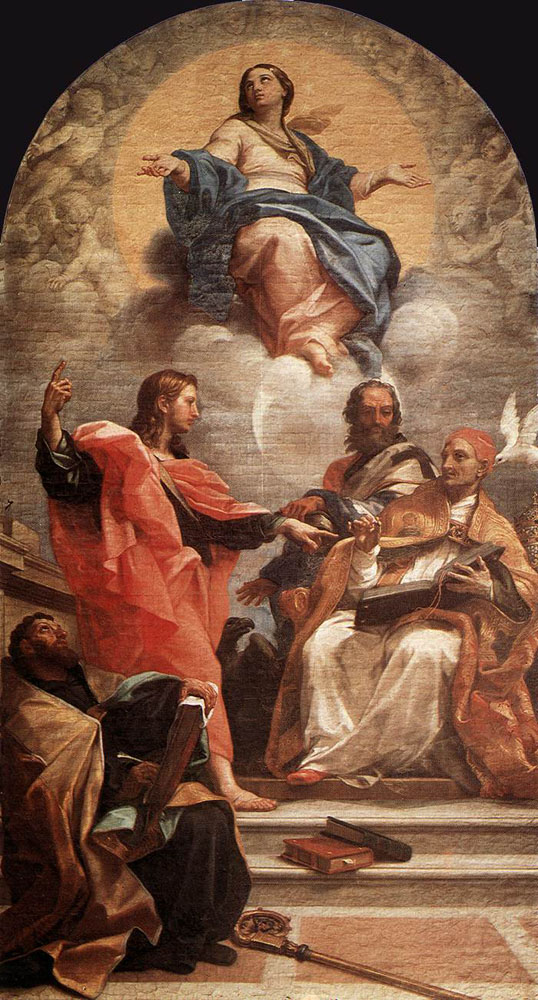
The Assumption of Mary

To many people, the Assumption of the Blessed Virgin looks like a case of the Catholic Church indulging it's fondness for odd Marian doctrines. But is that interpretation correct?

Well, let's start with a simple question. To what doctrines might the Assumption be related? The one to which its resemblance is most striking is obviously the Ascension of Christ. But there is an important difference. The Ascension was an action of Christ's own divine power, whereas in the Assumption, it is not an internal power of Mary but the external power of God which acts upon her.

What, then, is the connection between the two? I submit that it is a question of bodies. We profess not just that Christ was incarnate once, but that He remains incarnate. He did not become bodiless to ascend to the Father, but carried His bodily humanity with Him. And we, as members of the Body of Christ, will share in that glorification.

Why the unique privilege of Mary in sharing that glorification? Because she is the one who is most intimately connected with Christ in both body and spirit. In the Body of Christ she is the only one who was privileged to be the earthly origin of His humanity (including His body) by the overshadowing of the Spirit. Where others are related to the Body of Christ sacramentally, she is related both sacramentally and maternally.

Tuesday, August 08, 2006

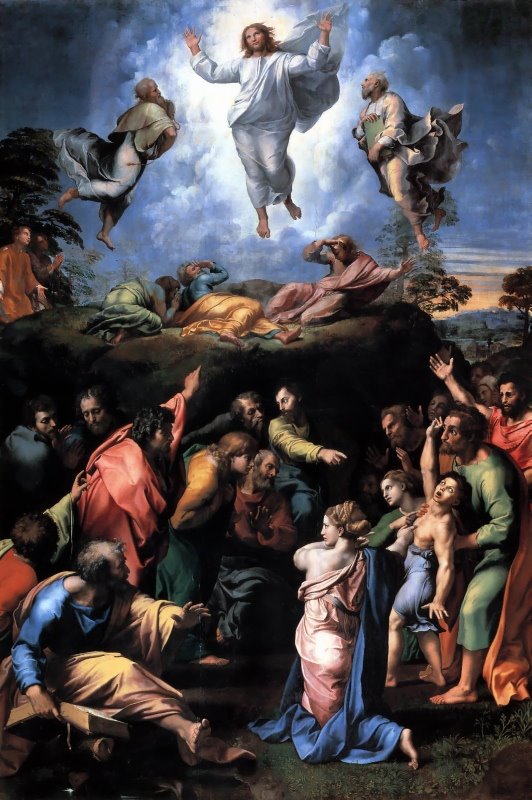
The Transfiguration of Our Lord

It's a bit late, but I thought I'd post a thought on the Transfiguration. I'm sure someone has expounded it before, but...

The light which shone from the transfigured Christ did not shine from above the cave of this world, though that Sun of the Good is its source. Rather, it shone within the "cave." It shone from the Body of Christ. And we are that body! We are the face and hands and feet through whom the divine light is to reach those who dwell in darkness and the shadow of death.

Tuesday, July 25, 2006

Liturgy, Kenosis, and NFP

One of the dimensions frequently overlooked in discussions of NFP and birth control is that of askesis or self-discipline. This is odd, because it figures prominently in Humanae Vitae.

21. The right and lawful ordering of birth demands, first of all, that spouses fully recognize and value the true blessings of family life and that they acquire complete mastery over themselves and their emotions. For if with the aid of reason and of free will they are to control their natural drives, there can be no doubt at all of the need for self-denial. Only then will the expression of love, essential to married life, conform to right order. This is especially clear in the practice of periodic continence. Self-discipline of this kind is a shining witness to the chastity of husband and wife and, far from being a hindrance to their love of one another, transforms it by giving it a more truly human character. And if this self-discipline does demand that they persevere in their purpose and efforts, it has at the same time the salutary effect of enabling husband and wife to develop to their personalities and to be enriched with spiritual blessings. For it brings to family life abundant fruits of tranquility and peace. It helps in solving difficulties of other kinds. It fosters in husband and wife thoughtfulness and loving consideration for one another. It helps them to repel inordinate self-love, which is the opposite of charity. It arouses in them a consciousness of their responsibilities. And finally, it confers upon parents a deeper and more effective influence in the education of their children. As their children grow up, they develop a right sense of values and achieve a serene and harmonious use of their mental and physical powers.

Yet most discussions of NFP and birth control quickly devolve into questions of why NFP is allowed to Catholics and contraceptives are not, as if all that mattered was implementation of a technique. While the question can certainly be answered on that level (natural law, etc.), it implies a thorough misunderstanding of what Christian life is to be.

The Christian life is about coming to participate, through Church and Sacrament, in the inner life of the Most Blessed Trinity.

And NFP, unlike its contraceptive alternatives, proposes a way consistent and complementary to way of fast and feast which the Church sets forward in her liturgical year. Indeed, in a certain sense, one can say that NFP is liturgical, for in its principle of self-denial it gives us the opportunity to enter into the kenosis, the self-emptying of Christ.

Friday, July 14, 2006

Pieta


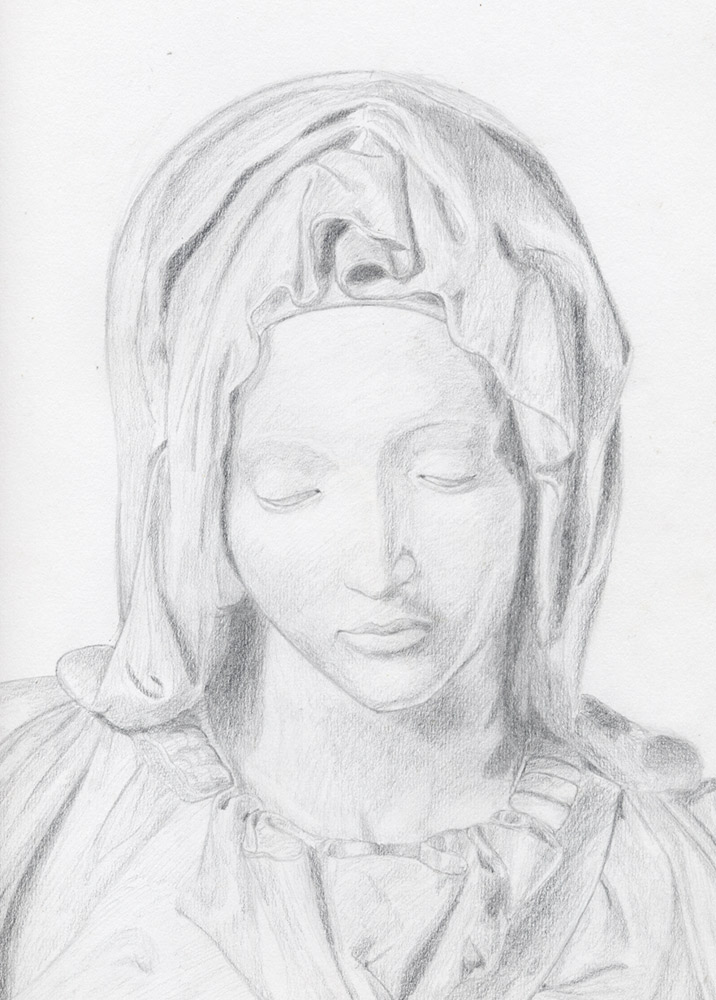
This is a drawing of mine from almost a year ago. It is, obviously, a study of Michelangelo's Pieta. It seemed appropriate given the title of this blog.

Why the title? If it is true that theology arises from doxology, then given the radical embodiedness implied by Christ's incarnation, theology cannot remain purely abstract but must express itself in tangible things like statues or icons. This isn't free of danger, but neither was the incarnation, as the Pieta itself makes quite clear.

Five Theses on Scripture

Thesis 1: The composition of the canon of scripture (what books belong in the Bible) cannot be determined by recourse to scripture both because of the circular nature of the argument and (even ignoring the circularity) because none of the proposed canons address the issue of canonicity in sufficient detail.

Thesis 2: The composition of the canon cannot reliably be determined by recourse to an "inner witness" because of its radical subjectivity. (Even the LDS church claims an "inner witness" for its canon, as do many Protestants for their canon, etc.)

Thesis 3: The question of the canon can therefore only be answered by recourse to the authority of the Church as expressed in magisterial rulings and patristic sources.

Thesis 4: The Protestant canon was not supported by any Church council or ecclesiastical ruling prior to the Reformation. (I'm 99% sure of this, but if I'm mistaken, please correct me.)

Thesis 5: The Protestant canon can only claim one Church Father (Jerome) as support, but even that isn't unambiguous, as his Latin translation of the Bible does include the deuterocanonicals.

Thursday, July 13, 2006

Being Love

"I am that I am." That is the name which God announced to Moses from the burning bush. God is He whose existence is absolute. Pair this with the description of God from St. John, that "God is love." Taken together, these revelations of God's identity also reveal the identity of man. Man can only truly exist insofar as he loves and participates in the love of God. That is why the two great commandments are to love God and to love our neighbor. For only in so doing can man fully become a "being" before God, who is Being itself.